Thought and Memory · 11 November 2026
The myth behind Thought and Memory: Odin's ravens Huginn and Muninn (Grímnismál)
Odin's greatest fear wasn't death. In the Grímnismál he fears for Huginn, his raven of thought, but fears more for Muninn, memory. The myth behind HEIDR's Thought and Memory.
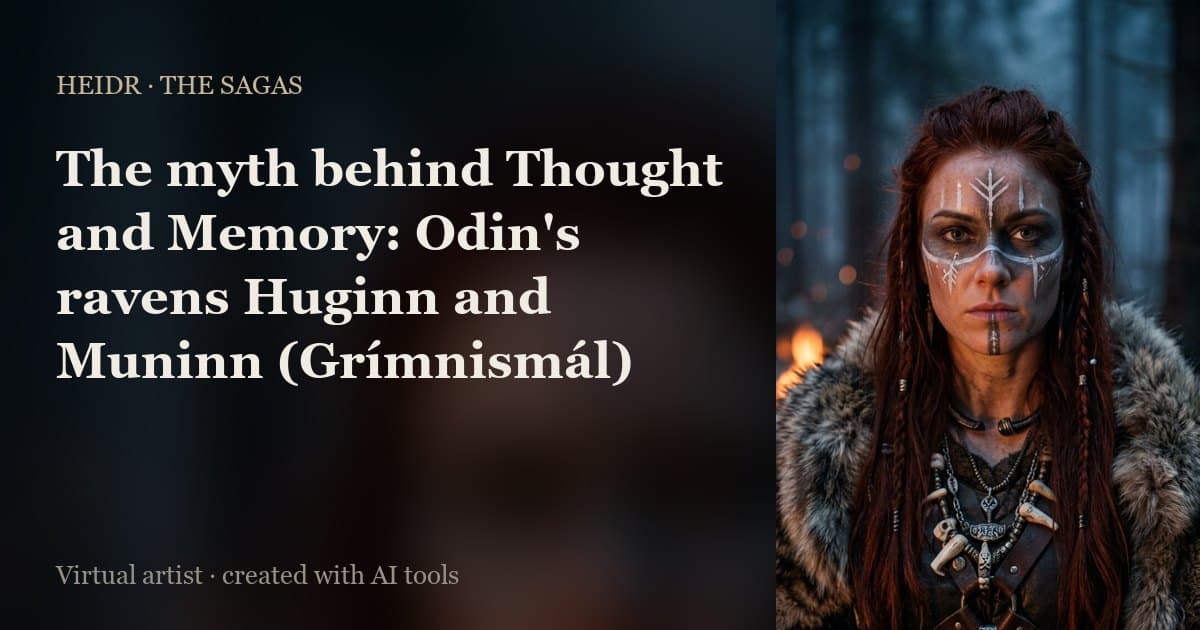
Odin's greatest fear wasn't death. He already knows how he will die: in the Völuspá the seeress tells of the day he goes out to fight the wolf at Ragnarök. Yet in the Grímnismál, when he speaks of what he fears, it is not the wolf. It is two birds that might not come home. Thought and Memory, HEIDR's slowest and most intimate song, is built on that one stanza.
Two ravens over the world
The fullest description comes from Snorri Sturluson's Gylfaginning, chapter 38, written in Iceland around 1220. Two ravens sit on Odin's shoulders and say into his ears all the news they see or hear. Their names are Huginn and Muninn. He sends them out at daybreak to fly over the whole world, and they come back by mealtime, so he learns of many things. That, Snorri says, is why people call him Hrafnaguð, the Raven-God.
Snorri's history of the early kings, the Ynglinga saga (chapter 7), tells it more plainly: Odin had two ravens he had taught to speak, and they flew far and wide through the land and brought him the news.
The stanza: Grímnismál 20
Snorri backs up his account by quoting an older poem, the Grímnismál, "the Speech of Grímnir", preserved in the Codex Regius of the Poetic Edda. Its setting is grim. Odin, disguised as a stranger called Grímnir, is seized by King Geirröd and set between two fires for eight nights to make him talk. When the king's young son Agnar brings him a drink, the god begins to speak: the halls of the gods, the wolves Geri and Freki, and then his ravens.
In the Old Norse text, stanza 20 ends:
óumk ek of Hugin, at hann aftr né komi-t, þó sjámk meir of Munin.
Henry Adams Bellows translated it as "For Hugin I fear lest he come not home, / But for Munin my care is more." That last line is the chorus of the song: "I fear for thought, he may not come / But more I fear for memory."
One honest caveat: Bellows notes that stanzas 18-20 also appear in Snorri's Edda and may have been added to the Grímnismál later. The stanza is old either way; we just cannot be sure it always stood in this poem.
Thought, memory, or desire?
The names are usually translated "Thought" and "Memory", and that is the reading the song follows. Huginn comes from Old Norse hugr: mind, thought, perception. Muninn comes from munr, a word with a wider range that includes memory but also care, longing and will, which is why some scholars prefer "mind and will". The poem never explains why Odin worries more about Muninn. Any answer is interpretation, and here is the one the song chooses: thought can always be renewed, but what is forgotten is lost.
Older than the poems
The ravens are much older than the 13th-century manuscripts. Gold bracteates from the 5th and 6th centuries show a figure on a horse, holding a spear, flanked by one or two birds, sometimes with a bird at his ear, which many scholars read as Odin and his ravens. A Vendel-period helmet plate from Sweden shows a rider with spear and shield and two birds above him. And a verse kept in the 13th-century Third Grammatical Treatise sends them to darker work: Huginn flies to the hanged, Muninn to the slain.
What the song does with it
Thought and Memory stays close to the sources. The ravens fly out "at the break of day" and come back, as in Gylfaginning. The second verse lists what they have seen: kings, the slain, fields of fire. Then it ends on the question the poem leaves open: "If memory never comes back / Who will remember us?" For a culture that kept its gods, laws and family histories alive in memory long before anyone wrote them down, it is not a strange thing for a god to fear.
Listen
- Full song on YouTube: HEIDR - Thought and Memory
- On Spotify: Seiðr, the album
Lyrics
[Intro]
Huginn... Muninn...

[Verse 1]
Thought flies out at the break of day
Memory follows the same grey way
Over the mountains, over the sea
Every night they come back to me

[Chorus]
Thought and memory
Fly, fly over me
Tell me what the world has done
Before the setting sun
I fear for thought, he may not come
But more I fear for memory

[Verse 2]
They saw the kings, they saw the slain
They saw the fields of fire and rain
They saw tomorrow, saw it burn
And still I wait for their return

[Chorus]
Thought and memory
Fly, fly over me
Tell me what the world has done
Before the setting sun
I fear for thought, he may not come
But more I fear for memory

[Bridge]
If memory never comes back
Who will remember us?

[Final Chorus]
Thought and memory!
Fly, fly over me
I fear for thought, he may not come
But more I fear for memory

[Outro]
Muninn...
HEIDR is a virtual artist: character, visuals and voice created with AI tools.
Sources
- Völuspá 51-55 (Bellows translation, with notes)
- Grímnismál 16-20 (Bellows translation, with notes and Old Norse text)
- Snorri Sturluson, Gylfaginning 31-40 (chapter 38: Of the food of the Einherjar and Odin)
- Snorri Sturluson, Ynglinga saga (Heimskringla), Laing translation, chapter 7
- Huginn and Muninn (Wikipedia)
- Grímnismál (Wikipedia)